Ebola Outbreak Awareness: Essential PPE for Healthcare Workers and Infection Control Teams
Updated: Jun 16

Current Situation
Singapore is stepping up public health measures following the Ebola outbreak in the Democratic Republic of the Congo (DRC) and Uganda to prevent imported cases, the Communicable Diseases Agency (CDA) announced on 19 May 2026.¹
Ebola is a serious infectious disease that can be fatal and is spread through close contact with the blood or body fluids of infected people or animals. Common symptoms include fever, headache, muscle pain, fatigue, vomiting, diarrhoea, and in some cases, bleeding. The World Health Organization (WHO) has declared that the outbreaks in DRC and Uganda constitute a Public Health Emergency of International Concern.¹
Healthcare workers are a key line of defence. Medical clinics and hospitals have been alerted, through professional circulars, to exercise vigilance and ensure early detection of possible suspect Ebola cases. Laboratories have also been advised of the testing procedures for Ebola.
While treatment options and vaccination programmes may be available in specific outbreak situations, infection prevention and control measures remain essential in reducing transmission risks within healthcare settings. Healthcare workers attending to suspected or confirmed cases should follow established protocols and use appropriate Personal Protective Equipment (PPE) alongside strict infection control measures.
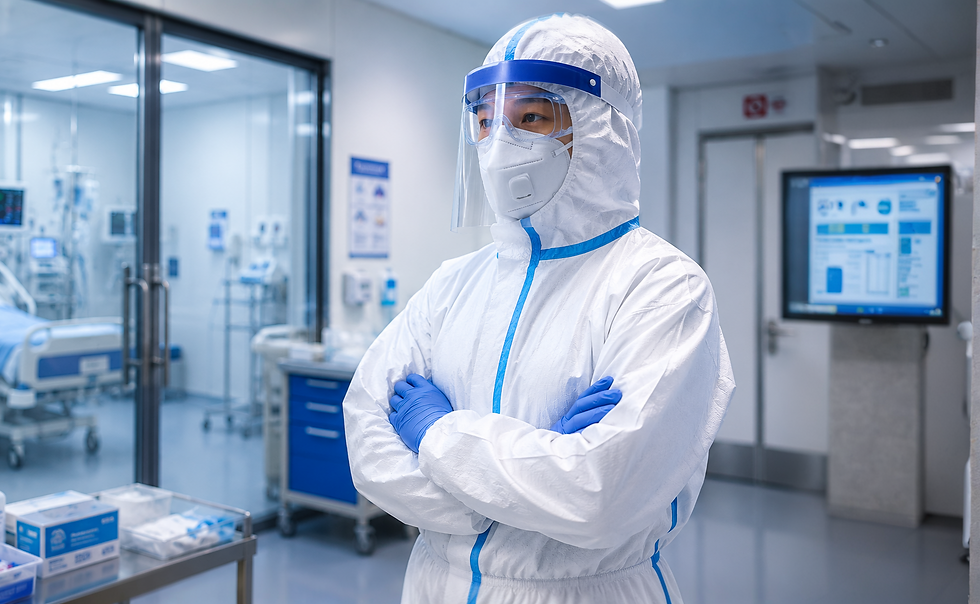
The Importance of PPE in Healthcare Settings
Effective infection prevention and control strategies rely on a combination of healthcare protocols, training, and appropriate Personal Protective Equipment (PPE). PPE serves as an important barrier that helps reduce exposure to infectious materials through contact, droplet, and airborne transmission routes.
The following are the core equipment components used to help protect healthcare workers during infectious disease outbreaks:
Respiratory Protection
N95, FFP2, or FFP3 respirators help protect against airborne pathogens, while PAPRs provide enhanced protection in high-risk clinical environments.
Eye & Face Protection
Safety goggles and face shields help protect mucous membranes from splashes of infectious body fluids and contaminated droplets.
Protective Clothing
Protective gowns and coveralls help reduce skin exposure and prevent contamination of personal clothing from infectious materials.
Hand Protection
Medical-grade gloves act as a primary barrier against direct contact with infectious materials, body fluids, and contaminated surfaces.
While PPE selection should always be based on facility protocols, risk assessments, and applicable healthcare guidelines, the following PPE solutions are commonly used to support infection prevention and control programmes in healthcare and laboratory environments.
Recommended PPE Solutions for Healthcare and Laboratory Environments
The following PPE solutions are commonly used to support healthcare workers in reducing exposure risks and maintaining infection prevention and control standards in healthcare and laboratory environments.
1. NIOSH Approved N95 Respirator
Dräger X-plore® 1380 N95 Respirator
The Dräger X-plore® 1380 N95 respirator is designed to provide respiratory protection in healthcare environments where exposure to airborne particles may occur, while maintaining wearer comfort during extended use. Its low breathing resistance and high filtration performance make it suitable for healthcare environments where exposure to airborne pathogens may occur.
 |
Key Features
|
2. Powered Air-Purifying Respirator (PAPR)
TECMEN TM-H2 PAPR
The TECMEN TM-H2 PAPR provides enhanced respiratory protection for high-risk healthcare procedures involving airborne biological hazards. The hood protects the face, neck, and shoulders against airborne particles, body fluids, and liquid droplets.
 | Key Features
|
3. Eye Protection
Bollé Safety Goggles
Safety goggles help protect healthcare workers against infectious droplets, bodily fluids, and splashes. They can also help reduce the risk of self-contamination by preventing direct contact with the eyes.
 |
Key Features
|
4. Protective Clothing
Revogard B056 Type 5/6 Disposable Coverall
The Revogard B056 Type 5/6 Disposable Coverall helps provide a protective barrier against airborne particles and minor liquid splashes. Designed with microporous breathable fabric, it offers lightweight comfort while supporting infection control measures in healthcare, laboratory, and emergency response environments.
 | Key Features
|
5. Medical-Grade Gloves
Ansell TouchNTuff™ 92-600
Ansell TouchNTuff™ 92-600 gloves provide a reliable barrier against infectious materials and chemical splashes. Designed for comfort and protection, they are suitable for prolonged use in demanding healthcare environments.
 | Key Features
|
Supporting Frontline Protection
Healthcare workers remain one of the most important lines of defence during infectious disease outbreaks. Appropriate PPE helps reduce exposure risks and supports infection prevention protocols in healthcare settings.
From respiratory protection and eye protection to protective clothing and gloves, selecting the right PPE can help healthcare professionals perform their duties more safely and confidently.
At AllAlloy Safety, we support healthcare facilities, laboratories, and frontline personnel with PPE solutions that help strengthen infection prevention efforts and workplace safety programmes. Appropriate PPE, when used alongside established healthcare protocols, plays an important role in supporting preparedness and protecting healthcare workers.
Contact AllAlloy Safety to learn more about PPE solutions for healthcare and infection control applications.
References
1. Singapore Communicable Diseases Agency (CDA). Precautionary measures stepped up in response to Ebola disease outbreak in Democratic Republic of the Congo and Uganda. Published 19 May 2026. Available at: https://www.cda.gov.sg/news-and-events/precautionary-measures-stepped-up-in-response-to-ebola-disease-outbreak-in-democratic-republic-of-the-congo-and-uganda